
If someone asked me what I could eat every day without getting bored, the answer would probably be Awadhi mutton biryani. But if someone asked me what I would choose for my last meal, there is only one answer. Sichuan hot pot.
The first is that it takes its time. A proper hot pot isn’t a meal you rush through. You sit around a bubbling pot for a couple of hours, ordering things, cooking them, eating, talking, ordering more. If these really were my last few hours, I’d happily spend them eating steaming meat and drinking beer until someone had to drag me away from the table.
The other reason is much less rational. It is mind-bogglingly, eye-wateringly spicy, and somehow, once you taste it, you don’t want to stop.
I had my first hot pot in Dalian in 2017. I was there on a company posting, part of a team of six, five Indians and one Chinese translator. We had a car and a driver who took us between the hotel, the factory, and whatever workshops and offices we needed to visit. Our translator, Li Moli, was not just a translator but a technical one, which is a rare and valuable thing. She could take exactly what we meant and convey it to our Chinese contractors without anything getting lost in between. She was dynamic, sharp, and got things done.
Dalian in winter does cold properly. Temperatures dropped to minus twenty, sometimes minus twenty-five. One such cold Saturday morning, I was already freezing at the office even after sitting next to the room heater. We worked half days on Saturdays and were usually free by noon. My friend Sarath took pity on me and asked if I wanted some relief from the cold. I said yes, assuming he probably had an afternoon Jack Daniel’s and Coke session in mind once we got back to the hotel. Instead, he asked Li Moli if she knew a good hot pot place nearby. She did. She found one close to our hotel and gave Sarath the details, and we asked our driver to drop us there directly.
The place looked like any other small mom-and-pop restaurant, with maybe half a dozen tables. There was nothing from outside to suggest that I was about to discover one of my favourite foods. We sat down and almost immediately a server came over. Unlike an Indian restaurant, there wasn’t a menu running into pages with a hundred variations of paneer and another hundred ways of preparing the same vegetables. Instead, there was a simple checklist with meat, seafood, vegetables, tofu, mushrooms and noodles, and you simply ticked what you wanted. Sarath knew enough Chinese to make quick work of it, went through the list, ticked a bunch of things and handed it back to the server.
Once we sat down, I noticed the table had a circular opening in the middle. I had seen something similar in India at places like Barbeque Nation, so I assumed it was some kind of built-in grill. A few minutes later, the server returned with a large steel pot and placed it into the opening. It had a partition running through the middle in an S shape. Something about it looked familiar, but I couldn’t quite place it.
Then came the two broths. One was clear and almost yellowish, the other was a deep, almost violently red colour. If you’ve eaten Maharashtrian food, you might recognise the resemblance to pandhra rassa and tambda rassa. The difference was that instead of two small bowls sitting alongside a thali, here they were poured into the two halves of this huge steel pot, which was heated from underneath. I had no idea what was actually in either broth. I hadn’t yet learned about Sichuan peppercorns, fermented bean paste or any of the other ingredients that went into it. All I knew was that one was clear, the other was bright red, and just looking at that red broth I could already imagine what it was going to taste like. As the two broths started bubbling away, I finally noticed the shape of the partition between them and suddenly it clicked. Yin and yang. The whole thing was shaped like the symbol.
Soon after, a huge tray arrived carrying everything Sarath had ordered. Everything was raw. Thinly sliced beef and lamb, prawns, fish balls, vegetables, tofu, mushrooms and a few things I couldn’t identify. I was already hungry, and the smell coming from that red broth was making things considerably worse.
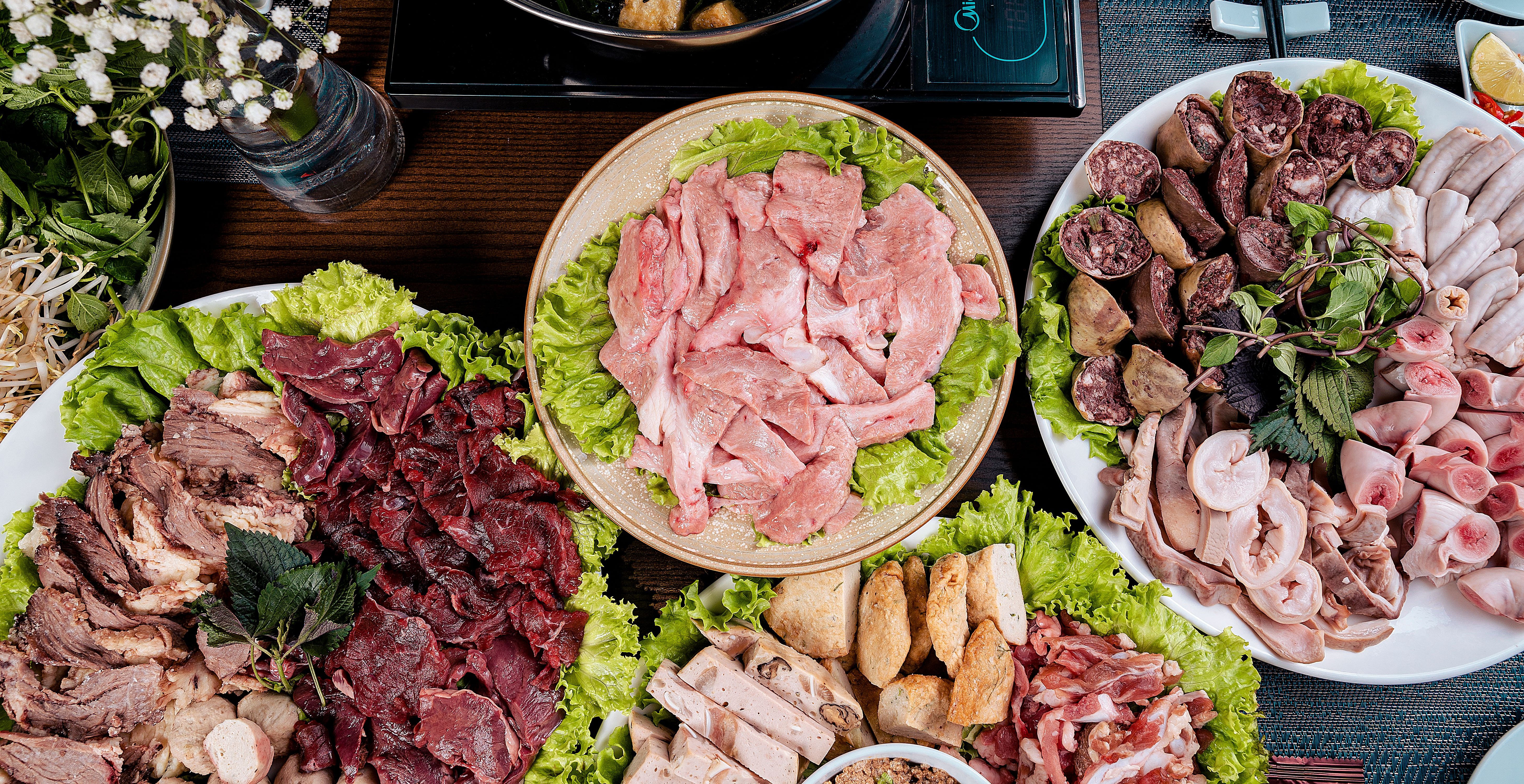
Sarath gave me a quick lesson on how to eat it. Thin slices of meat needed only a few seconds in the boiling broth. Vegetables took longer. Some things went in towards the end. He explained the dipping sauce as well, which was another thing I had never encountered before. Instead of one sauce being served with the meal, you built your own from the ingredients at the condiment station.
I consider myself someone who handles spice well. I grew up in India. I have opinions about how much chilli belongs in things. So naturally, I went straight for the red side. I picked up a thin slice of beef, dropped it into the boiling broth, waited a few seconds and pulled it out. I dipped it into the sauce and took a bite.
If you say you like spicy food and are as overconfident as me about your spice tolerance, allow me to introduce you to Sichuan hot pot. What the fuck was that spicy taste? Everything was burning. I could feel my sinuses opening one by one, my eyes watering and my mouth going numb. The Sichuan pepper wasn’t just hot; it made my mouth tingle and go numb at the same time. I reached for my beer and from the corner of my eye I could see Sarath laughing. I looked at him and asked, “What the fuck, man? Why didn’t you tell me?” He laughed even harder. Apparently, he had been waiting for exactly this reaction. Yet instead of dropping the chopsticks on the side and quitting this food altogether, somehow I was being drawn towards it even more strongly. I went back for another piece. Then another. Every bite hurt, and every bite made me want the next one. Within minutes I was sweating in a restaurant while it was minus twenty degrees outside. Every bite was telling me to stop, and my brain was telling me to take another one.
By the end of the meal I was warm, slightly wrecked and completely in awe. I couldn’t believe people here ate something this brutally spicy so casually and actually enjoyed it. I had always thought I had a good tolerance for spicy food, but that afternoon in Dalian gave me a completely new respect for Chinese food. And I had a feeling this wasn’t going to be my last hot pot.
That was the beginning. Over the rest of that posting, hot pot became one of the things I looked forward to most. The cold outside, the heat inside, the bubbling pot in the middle of the table and a few hours spent sitting around it, mostly by myself, sometimes with a friend or one of my Chinese colleagues. It became one of those small things I looked forward to after a long cold day at work.
Then my manager in India messaged to say I had to travel to Chengdu for an inspection with the Finnish team. Sarath had lived in Chengdu before, so I asked him about the place and his advice was immediate: when you’re in Chengdu, don’t miss the hot pot. Chengdu is the home of Sichuan food, and if Dalian had introduced me to hot pot, Chengdu was the pilgrimage.
I have had hot pot in a few different cities in China since that first meal. Each place had its own variation, but the Sichuan version stayed with me. In 2023, after almost five years away from China, I returned to Xuzhou. That week in Xuzhou I ate hot pot twice, and that was the last time I had it. December 2023. It will be three years since then, and I’m still craving a good, steaming, fiery hot pot, but to no avail.
There are no places in Pune that have quite filled the gap. There used to be Mandala Kitchen in Kalyani Nagar, but I think it has shut down now. I’ve looked around for alternatives but haven’t found anything that gives me the same feeling.
Maybe that’s why I remember those meals so clearly. You sit down, the broth starts boiling, meat goes in, someone fishes it out a few seconds later, you drink, talk, eat and order more. A couple of hours disappear without you really noticing.
And that is probably why I would choose it as my last meal. If I really had only a few hours left, I wouldn’t want something quick and elaborate served on a plate. I’d want that bubbling red broth in front of me, a cold beer beside me and enough thinly sliced beef to keep me going until someone had to tell me it was time to leave.