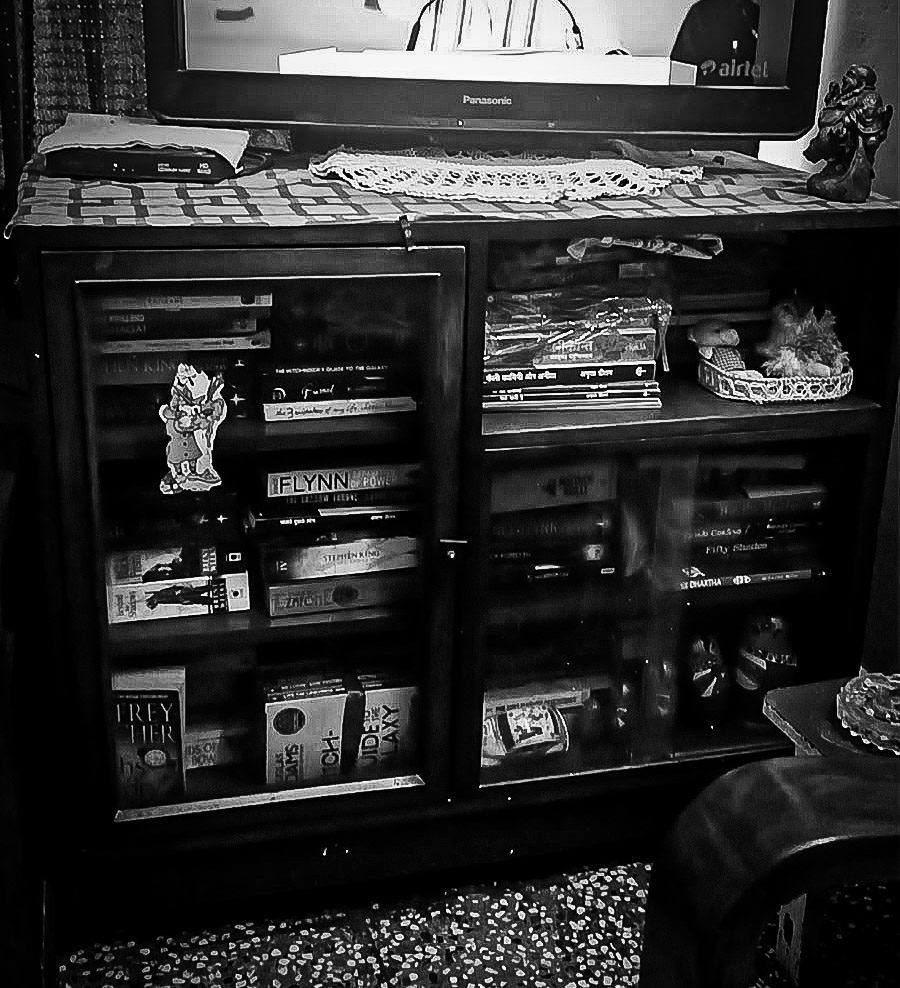
I was sixteen, my 10th board exams were over, and I was waiting for the results. Summers in Bhilai are harsh, with temperatures climbing to 45 or 46 degrees, so I wasn’t allowed out in the afternoons to play cricket, which was the only thing I wanted to do. There was no cricket on TV either, and back then I’d watch any match, whoever was playing. I was bored of watching TV, had nothing to do and far too much energy, so I did the last thing a bored teenager wants to do and picked up a book. We had a bookcase with glass doors that also served as the TV stand, and it still does. I opened it and took out a book at random. It was The Odessa File by Frederick Forsyth.
Everyone on my father’s side of the family read. My grandmother went through novels in Hindi and English as if they were comics. My father used to bring her eight or ten at a time from a library in Sector 10, a private one I think, which isn’t there any more, and she’d finish them within the month. The books in that bookcase belonged to my father, my grandmother and my uncle, my father’s elder brother, who isn’t with us any more. I never asked which books were whose, but I think most of them were my uncle’s.
The same night I picked it up, I was lying on the bed in the inside room with the book open when my father walked in and asked what I was reading. I showed him the book and told him I’d found it in the bookcase. He didn’t say much, only that I shouldn’t fall into the habit, because I had important years of studying ahead of me. I finished it in a couple of weeks.
I’d read comics before, and whatever stories school made us read, but this was something else. It felt as if a part of my brain I’d never used had switched on. Comics were obviously made up, but this story could have happened. A young German journalist, Peter Miller, comes across the diary of a man who survived the camps, decides to track down the SS officer in it, and walks straight into ODESSA, a network of old Nazis who will kill to stay hidden. He takes on a false identity, gets inside, and the whole time you know one slip will finish him. I was hooked, and I read it picturing every scene. Then there was the Jaguar. Miller drives a Jaguar XK150, and at one point ODESSA plants a bomb in it that’s meant to go off on the first hard jolt. It never does, because the Jaguar’s suspension is too stiff to set it off. The car saved his life just by the way it was built, and at sixteen I thought that was the best thing I’d ever read. Twenty-four years later I’d remembered it slightly wrong, as a minefield, but I’d remembered the suspension exactly. It turns out the bomb does go off later, when someone else drives the car over a snow-covered pole. That part I’d forgotten completely.
I didn’t know it then, and almost nobody did, but Forsyth, a former Reuters and BBC correspondent, had been passing information to MI6 through the Cold War, for more than twenty years. He only revealed it in 2015, just before his memoir came out. John le Carré and Graham Greene had both worked for British intelligence as well, which may be why all three wrote spy stories that read as if they came from the inside.
What I read next was nothing like it: Danielle Steel and Mills & Boon, chosen entirely on their covers. I didn’t know what they were and didn’t read the back to find out. I’ve never stuck to one genre since. I’ll read whatever looks interesting, whether it’s science fiction, fantasy, a thriller, YA or, for a while, romcoms, though that was a phase. Until I finished college, that bookcase was all I had, and it was a treasure trove. I read The Godfather from it too. I didn’t buy a novel of my own until I started earning. The only book I remember buying before that was a biography of Einstein at IIT Bombay’s Techfest, and even that I split with a friend. My father’s warning had been about the years ahead, and as it turned out, reading did slow down through college. It only came back properly when I was living alone in Jamshedpur with nothing else going on, getting through four or five novels a month.
When I did start buying my own books, I bought them the same way, on the cover, and I still do. I have a weakness for beautiful and unique things, and it’s hard to ignore. If a cover is beautiful or strange enough, there’s a good chance I’m leaving the shop with it without knowing what’s inside, which I know isn’t how someone who reads and writes is supposed to choose books. It has backfired at least once. There was a big Crossword in Amanora Mall in Pune, spread over two floors, where I loved spending hours before it closed, and I once bought a book there purely for its cover, got home, started reading and realised I’d bought the middle of a series.
A few things in our house have been there since before I was born, and the bookcase is one of them. Over the years I’ve asked my mother to let go of most of them and get something new, and she has, reluctantly, for a few. I’ve never once asked her to replace the bookcase.
I don’t know if that copy of The Odessa File is still in it. A few years ago my mother gave away a lot of my old novels and comics, and I wouldn’t be surprised if it went out with them. I don’t usually reread books, but that one will be an exception. Right now I’m in a slump, reading far less than I’d like, and I’m hoping next year sorts that out. My father told me not to fall into the habit. Listening to him would have saved me lakhs of rupees by now, and plenty more in the years to come, but I’d never have met Peter Miller, Frodo, Roland Deschain, Harry Potter or anyone else I’ve found in books since, and it would have been a boring, unimaginative, closed-minded life. I shudder to think about it.
This is the fiftieth post on The Standard, and a fair number of them are about books. If I hadn’t opened that bookcase in the summer of 2002, I doubt there would have been a first.